March is Women’s History Month — a time set aside to remember, celebrate, and honor the women who built the world we inherited. But this March, in 2026, the act of remembrance feels different. It feels urgent. Because the forces that have always worked to silence women, to erase queer people, to push our stories off shelves and out of classrooms and out of public life — those forces are not dormant. They are active. They are organized. And they are well-funded.
This is not a post about despair. It is a post about what we know to be true when we look clearly at history: that the women and queer people who came before us faced moments like this one, and they did not disappear. They organized. They created. They found each other. They refused.
We are their continuation.
—–
## What Is Happening Right Now
Let’s be clear-eyed about the moment we are living in, because clarity is the first act of resistance.
Over the past year, DEI programs have been gutted at the federal level, with executive orders dismantling diversity, equity, and inclusion initiatives across government agencies. More than $800 million in LGBTQI+ research grants were terminated by mid-2025 alone. Scientists studying health disparities in queer communities — the people whose work keeps our community alive and counted — have had their projects cancelled midstream, their careers disrupted, their data left incomplete.
The corporate sector has followed. Major companies have abandoned DEI commitments, triggering a chilling effect felt across industries. LGBTQ+ charities are watching funding evaporate. In the UK, National Student Pride — a two-decade institution that gave queer students visibility, community, and access to inclusive employers — announced that 2026 will be its final year, citing a two-thirds drop in corporate funding directly tied to DEI rollbacks.
In publishing, authors and agents report that for the first time in a decade, editors are citing the cultural climate as a reason to pass on queer stories — particularly for young readers. Seven of the ten most banned books in America feature LGBTQ+ characters. Our stories are being removed from library shelves. Our children are being told that their lives are inappropriate content.
And yet. And yet. History has seen this before.
—–
The Women Who Refused
Women’s History Month exists because women were written out of history. The lesson embedded in the very existence of this observance is that erasure has always been the strategy — and it has never worked permanently.
Bayard Rustin organized the 1963 March on Washington and was deliberately hidden from the podium because he was gay. The records were edited. The photographs were cropped. He was erased in real time. And yet we know his name.
The women of the early labor movement — the 15,000 who marched in New York City in 1908 demanding shorter hours, better wages, and the right to exist as full human beings in public life — were not written into the history books they deserved. They were minimized, dismissed, and in many cases, forgotten. And yet the movement they built changed the world.
Marsha P. Johnson threw the first brick, or maybe she didn’t — the historical record is contested in the way that queer history always is, because queer history has never been given the archival care it deserves. But she was there. Miss Major was there. Sylvia Rivera was there. Trans women of color were at the origin of the modern LGBTQ+ rights movement, and they were systematically excluded from the organizations that movement later built. And yet we know their names. And yet the movement exists.
The pattern is old. The women and queer people who are most threatening to systems of power are the ones most aggressively erased. And the erasure never fully takes — because community is not erased as easily as a policy. Story is not erased as easily as a budget line.
—–
Why Empathy Is an Act of Resistance
At Queer Reflection, we were built on a single foundational belief: that the failure of empathy is at the root of most injustice. That when people cannot imagine the inner life of someone different from themselves — cannot feel what it costs to be afraid of your own family, or invisible in your own country, or erased from your own history — they become capable of enormous harm without ever seeing themselves as harmful.
The rollback of DEI programs, the book bans, the defunding of queer research — these are not, at their core, policy disagreements. They are failures of empathy, institutionalized and made law. They are what happens when the people in power have never been asked to sit with the reality of a life different from their own.
This is why the work of immersive storytelling, of empathy-building, of creating experiences that make the interior lives of LGBTQ+ people undeniable and real — this work is not peripheral to the political moment. It is central to it.
When we place someone inside a coming out story, when we let them feel the weight of a family dinner where one wrong word could change everything, when we ask them to inhabit the experience of being seen or not seen, loved or not loved, erased or witnessed — we are doing something that a policy brief cannot do. We are making erasure impossible from the inside.
—–
This Women’s History Month, We Celebrate the Resisters
There is a particular kind of woman we want to honor this March — the woman who was told her story didn’t belong and told it anyway.
Audre Lorde, who said that poetry is not a luxury, and meant it as a declaration of survival. Cherríe Moraga, who co-edited *This Bridge Called My Back* and insisted that the most marginalized voices belong at the center of feminist thought, not the margins. Barbara Jordan, whose voice made rooms pay attention. Sylvia Rivera, who fought for a movement that kept trying to leave her out of it. Every unnamed woman who passed stories down in whispers because that was the only way they survived.
And the resisters who are alive right now, today, in 2026 — the librarians who are refusing to remove books, the teachers who are finding ways to hold space for queer students, the writers who are still writing, the researchers whose work continues even after their grants were cancelled, the organizers building new structures as old ones collapse.
They are the shoulders we stand on. And we are in the process of becoming the shoulders someone else will stand on.
—–
What We Can Do
Queer Reflection is an empathy engine, not an advocacy organization. But we believe that empathy, taken seriously, leads to action. So here are the forms that action can take right now:
Read and share queer stories. Buy queer books. Request them at your library. Read them with your kids. The market signals matter, and the visibility of queer stories in circulation is itself a form of resistance to the forces trying to remove them from shelves.
Support the organizations doing the work. The Audre Lorde Project. Trans Lifeline. Lambda Legal, which is actively challenging anti-LGBTQ+ executive orders in court. Your local LGBTQ+ community center, if it’s still standing.
Bear witness. When queer people tell you about their lives — when a trans person describes what it costs them to exist in public right now, when a queer woman describes the particular erasure she navigates in both feminist and LGBTQ+ spaces — receive that story as the gift it is. Don’t manage it. Don’t minimize it. Sit with it.
Tell your own story. If you are queer, your story is an act of resistance right now. The systems that want to erase you are counting on your silence. Queer Reflection exists to hold space for exactly that — for the messy, complicated, luminous reality of lives that refuse to be made invisible.
—–
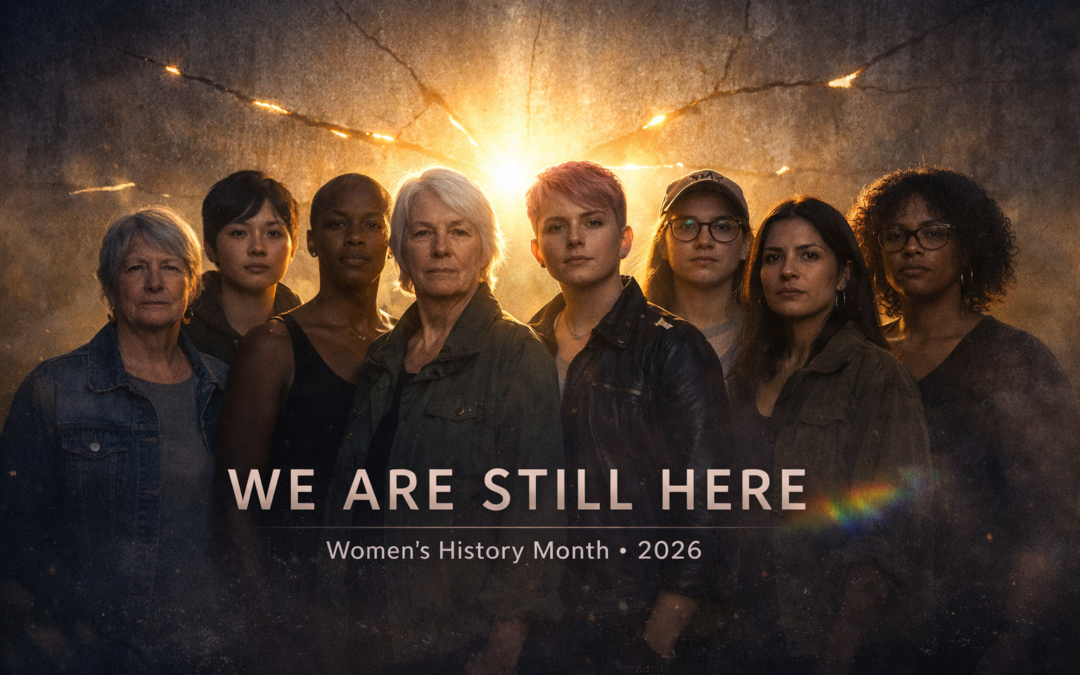
We Are Still Here
They have tried to erase us before. In living memory and in the distant past, in policy and in publishing, in the cropping of photographs and the burning of libraries and the quiet removal of a checkbox from a form.
We are still here.
This Women’s History Month, we celebrate every woman and every queer person who showed up anyway — who created anyway, who loved anyway, who refused to accept the terms of their own erasure. We celebrate them by continuing. By building. By telling the truth about our lives in every medium available to us.
Story is resistance. Empathy is power. Design is how we make both seen and felt.
We are still here.
—–
Queer Reflection is an immersive empathy engine dedicated to deepening understanding of LGBTQ+ lived experience through interactive encounters and emotional storytelling. Learn more about our work and how you can support it at QueerReflection.com.