
We Don't
Wait Our Turn
On trans rights, political cowardice dressed as pragmatism, and why empathy demands we hold the line — for all of us.
There is a particular kind of wound that comes not from your enemies, but from your allies. The kind that arrives gift-wrapped in the language of strategy, patience, and political realism. Barney Frank — pioneer, champion, a man who carried the weight of LGBTQ+ rights on his shoulders for decades — recently suggested that the movement should slow down on trans rights. Move with more deliberation, he argued. Pick our battles. Don't let trans visibility become a liability at the ballot box. It is, on its surface, the advice of someone who has fought long and hard and lost often enough to be cautious. I hear that. And I reject it completely.
Not because Barney Frank is a bad man. Not because experience doesn't matter. But because equal rights are not a negotiation, and the people being told to wait are not abstractions on a political chessboard. They are human beings whose lives, safety, and dignity are being dismantled in real time — in legislatures, in school boards, in emergency rooms, in the quiet devastation of young people who no longer see themselves reflected anywhere that matters.
Empathy is not a feeling. It is an obligation. And obligation does not come with a patience clause.
History Did Not Wait
Let us be precise about what our community has actually done, because the revisionist mythology of "incremental progress" tends to erase what really moved the needle. The Stonewall uprising of 1969 was not a politely worded petition. It was trans women and queer people of color — many of them unhoused, all of them criminalized — throwing bottles at police because they had been given no other option. It was Marsha P. Johnson, a Black trans woman, standing at the front of a movement that the respectable gays of the era would have preferred to keep quiet.
ACT UP did not ask nicely. They stormed the FDA. They laid their dying bodies on the steps of the New York Stock Exchange. They interrupted Catholic mass at St. Patrick's Cathedral. They were called extremists, embarrassments, liabilities. And they saved hundreds of thousands of lives precisely because they refused to moderate their rage into something more palatable.
Marriage equality — that crown jewel of incremental progress — only arrived because ordinary queer people loved each other loudly and publicly and legally for decades, daring the law to catch up. When it did, it wasn't a gift. It was a concession extracted through relentless, unapologetic presence.
The arc of justice does not bend on its own. Someone has to bend it — usually by refusing, loudly and at personal cost, to accept that justice is a future amenity.
Patience Is Not a Strategy. It Is an Alibi.
When Barney Frank speaks of deliberation and sequencing, he is invoking a framework that has a name in political science: incrementalism. The idea is that lasting social change requires building broad coalitions, avoiding wedge issues, and accepting half-victories as the price of staying in the game. It is, in many contexts, wise counsel.
But incrementalism has a shadow side that its proponents rarely acknowledge: it always asks the most vulnerable to wait the longest. It was Black Americans who were told that the 13th Amendment was enough for now, that the 14th could come later, that the Voting Rights Act might inflame too many people. It was women who were told that suffrage was the priority, that economic equality could follow. It is always the most marginalized — those whose humanity is most contested — who are asked to step to the back of the justice queue for the good of the broader coalition.
And before anyone argues that those were different times — that the system eventually corrected itself — consider what just happened. On April 29, 2026, the Supreme Court issued its 6-3 ruling in Louisiana v. Callais, effectively gutting Section 2 of the Voting Rights Act of 1965. The provision that for six decades protected Black and minority voters from racial discrimination in redistricting has been hollowed out, clearing the way for states to redraw maps that dilute minority electoral power ahead of the 2026 midterms. A civil rights achievement it took a century of struggle to win, dismantled in a single opinion. The rights we were told were secured? They were never secured. They were borrowed time.
This is the lesson incrementalism keeps refusing to learn: rights without ongoing, ferocious defense are not rights. They are temporary permissions. And the moment the political winds shift, those permissions are revoked — first from the most vulnerable, and then from everyone else.
This is not strategy. This is sacrifice. And the people being sacrificed are always the ones who were already carrying the heaviest load. Trans people — particularly Black and brown trans women — face epidemic-level violence, staggering rates of homelessness, and systematic exclusion from healthcare and employment. Telling them to wait is not a political calculation. It is a moral failure dressed in the language of pragmatism.
The cruelest irony is this: the conservative right never deliberates about rights. They move fast, they coordinate, they use every lever available to strip protections away before anyone can organize a response. The ACLU documented more than 600 anti-transgender bills introduced at the state level in 2025 alone — itself a record, following more than 500 in each of the two years prior. By February 2026, Trans Legislation Tracker was already counting 740 bills under consideration across 42 states, with more expected. 2025 was the sixth consecutive record-breaking year. They are not waiting. So why, exactly, should we?
What "Conservative Values" Actually Means
Let's dispense with the euphemism. When politicians speak of "conservative values" as a justification for anti-trans legislation, they do not mean thrift, self-reliance, or small government. They mean hierarchy. They mean a social order in which some bodies are legible and protected and others are not. They mean the maintenance of a world in which gender, sexuality, and identity conform to a narrow and historically contingent norm — one that has always required the suppression of those who naturally, beautifully, necessarily fall outside it.
This is not a values debate. It is a power debate. And empathy — real empathy, the kind that requires you to sit with the full weight of another person's experience rather than a comfortable abstraction of it — makes that distinction impossible to ignore.
Empathy is the technology that breaks hierarchy. When you genuinely understand what it means to be a trans teenager in a state that has made it illegal for a school counselor to acknowledge your existence, you cannot then calmly advise a slower legislative approach. Empathy doesn't allow for that distance. Empathy insists on urgency.
To see someone clearly — to really see them — and then to suggest they wait for their rights is not pragmatism. It is cruelty with better manners.
Trans Rights Are Queer Rights. Full Stop.
There is a strand of thought in certain parts of the LGBTQ+ community — comfortable, assimilated, largely cisgender — that positions trans visibility as a strategic liability. The logic goes: trans people are too "out there," too politically costly, too easy for conservatives to weaponize. If we could just focus on the issues that poll better...
This is not only morally bankrupt. It is historically illiterate.
Trans people were at the founding of this movement. Trans people marched, bled, organized, and died so that the rest of us could eventually live lives that felt, if not fully free, at least survivable. The notion that we would now use their existence as a bargaining chip — that we would trade their safety for our comfort — is a betrayal so profound it should be unspeakable.
And yet it is being spoken. By respected figures. In reasonable tones. Which is precisely what makes it dangerous.
Solidarity is not a sentiment. It is a practice. It means that the question "what will it cost us politically?" is always secondary to the question "what is being done to our people?" If we cannot hold that line — if we cannot maintain the basic covenant that no one in this community is expendable — then we have already lost something that no election can restore.
Empathy as Resistance
At Queer Reflection, we talk about empathy as power. Not soft power. Not diplomatic power. Power as in: the capacity to change a mind, shift a world, refuse the terms being offered and insist on better ones. Empathy, practiced at full depth, is one of the most radical acts available to us.
Because here is what empathy actually requires: it requires that you stop seeing the people whose rights are being debated as a political category and start seeing them as people. It requires that you sit with the fear of a trans child in a state that has decided she doesn't deserve a doctor who affirms her. It requires that you feel the weight of a trans man who has to calculate, every single day, whether it is safe to exist visibly in the world.
When you do that — when you let it land — waiting becomes indefensible. You cannot feel all of that and then turn to a spreadsheet of polling data and conclude that delay is a reasonable response.
This is not naive. This is not the politics of purity or the luxury of those who have never lost an election. This is the understanding that movements which abandon their most vulnerable members in the name of electability tend to win smaller and smaller victories until they are no longer movements at all.
We Hold the Line. Together.
None of this means we don't think strategically. Coalition-building matters. Messaging matters. Understanding the political terrain matters enormously. Barney Frank is right that winning requires discipline and sometimes uncomfortable choices.
But the choice of who gets protected is not a tactical question. It is a foundational one. And our answer, as a community, has to be: all of us. Every time. Without condition.
That means showing up for trans people in the same way that trans people have always shown up for us — not because it is easy or popular or strategically optimal, but because that is what it means to be in community with someone. It means using every tool available: legal challenges, electoral organizing, economic pressure, storytelling, art, presence. It means making the cost of erasing trans people higher than the benefit.
And it means refusing — with love, with clarity, with the full force of a community that has survived so much — to accept the premise that equality is a resource to be rationed.
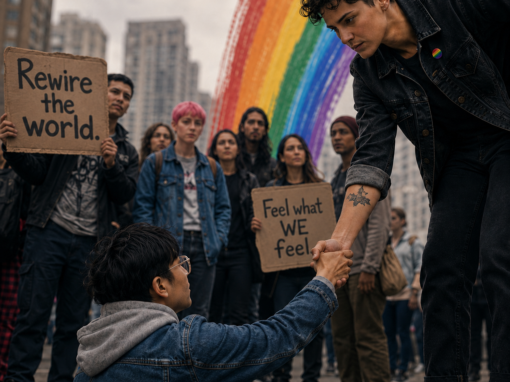
We have always known something that the architects of incrementalism tend to forget: rights deferred are rights denied. And we have always, at our best, responded not with patience but with presence. Not with waiting but with witness.
The question is not whether trans people deserve full equality. They do. Unambiguously, unconditionally, right now. The question is whether we have the courage to say so — loudly, together, without hedging — and to act as though we mean it.
I believe we do. I have to believe we do.
Because the alternative — a movement that makes peace with its own diminishment, that trades its most vulnerable members for a few more percentage points in a midterm — is not a movement worth fighting for.
We don't wait our turn. We never have. And we are not about to start now.
Empathy is not a feeling. It is a refusal. A refusal to look away, to calculate, to treat another human being's existence as a political inconvenience. It is the most radical thing we have. And it belongs to all of us.